
Last updated November 3, 2026
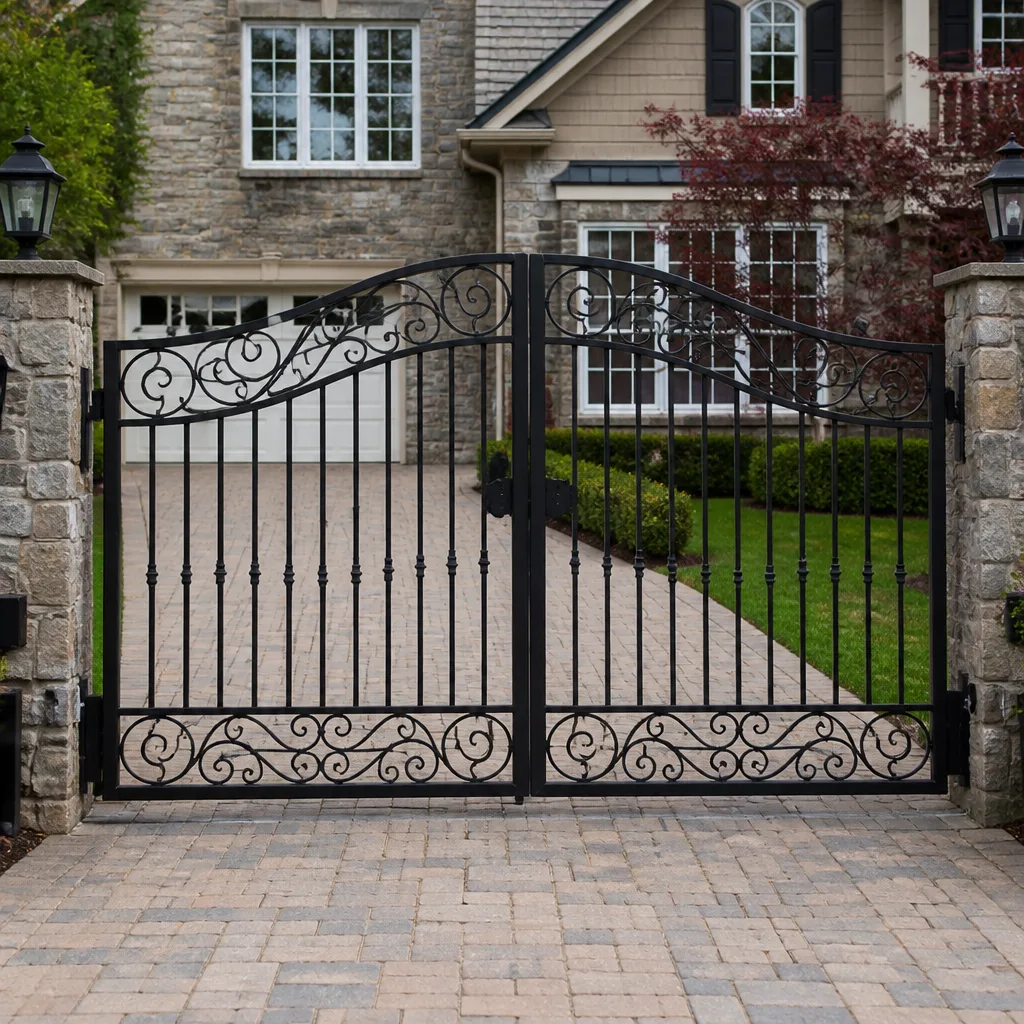 Wrought iron
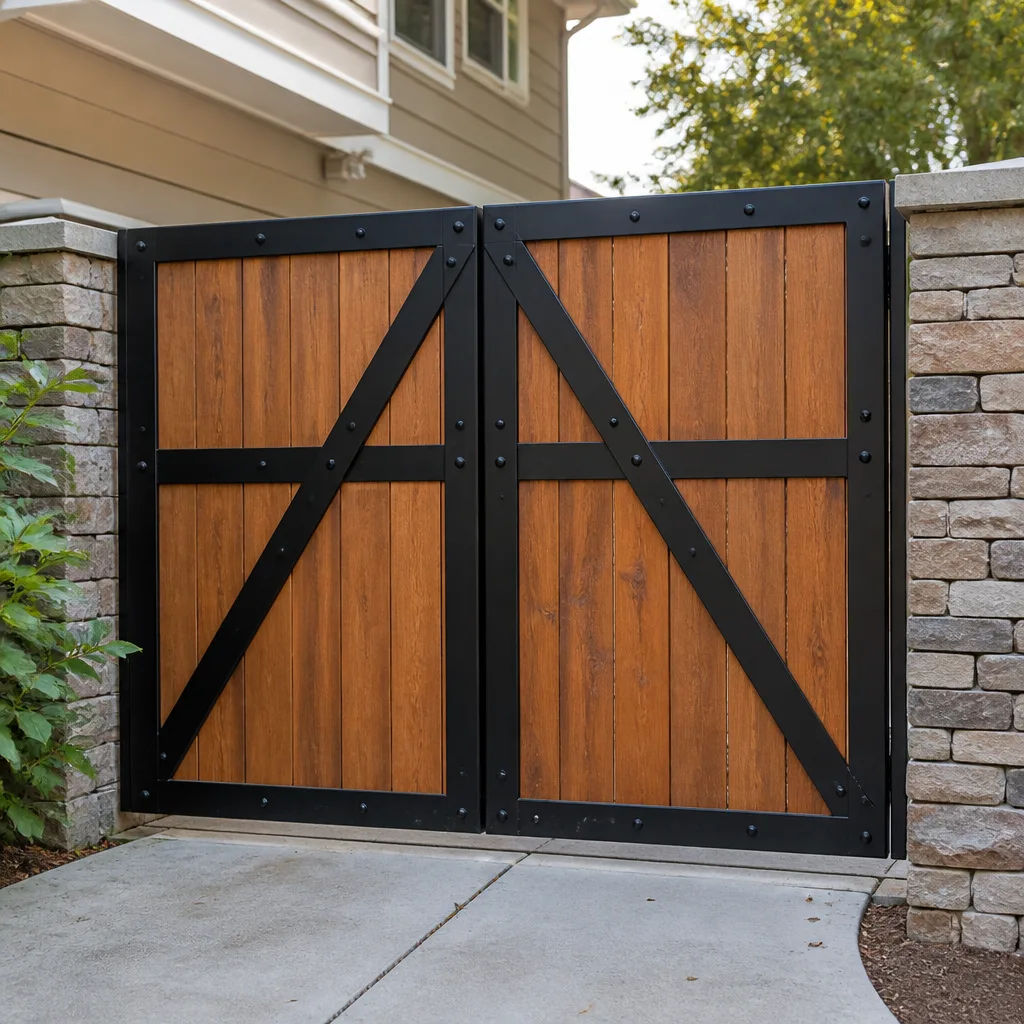 Wood & steel frame
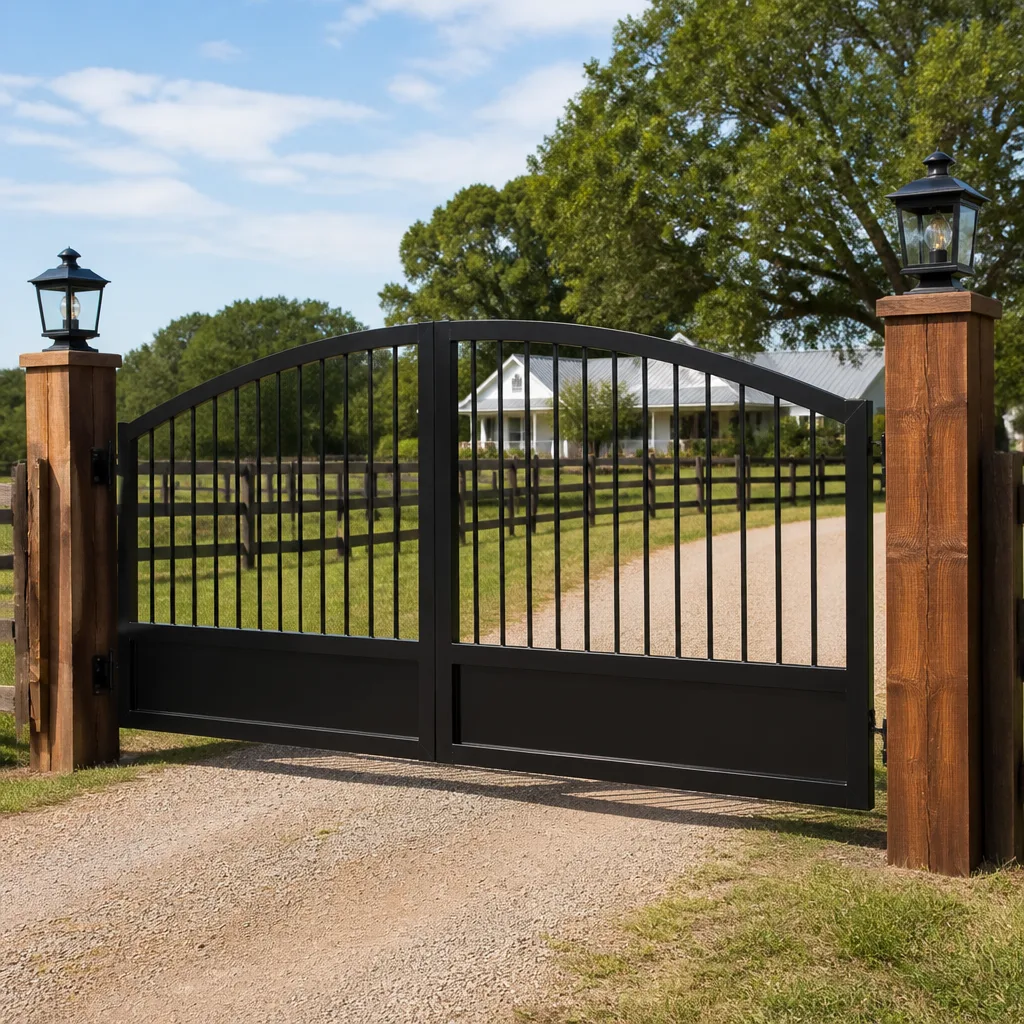 Farm & ranch
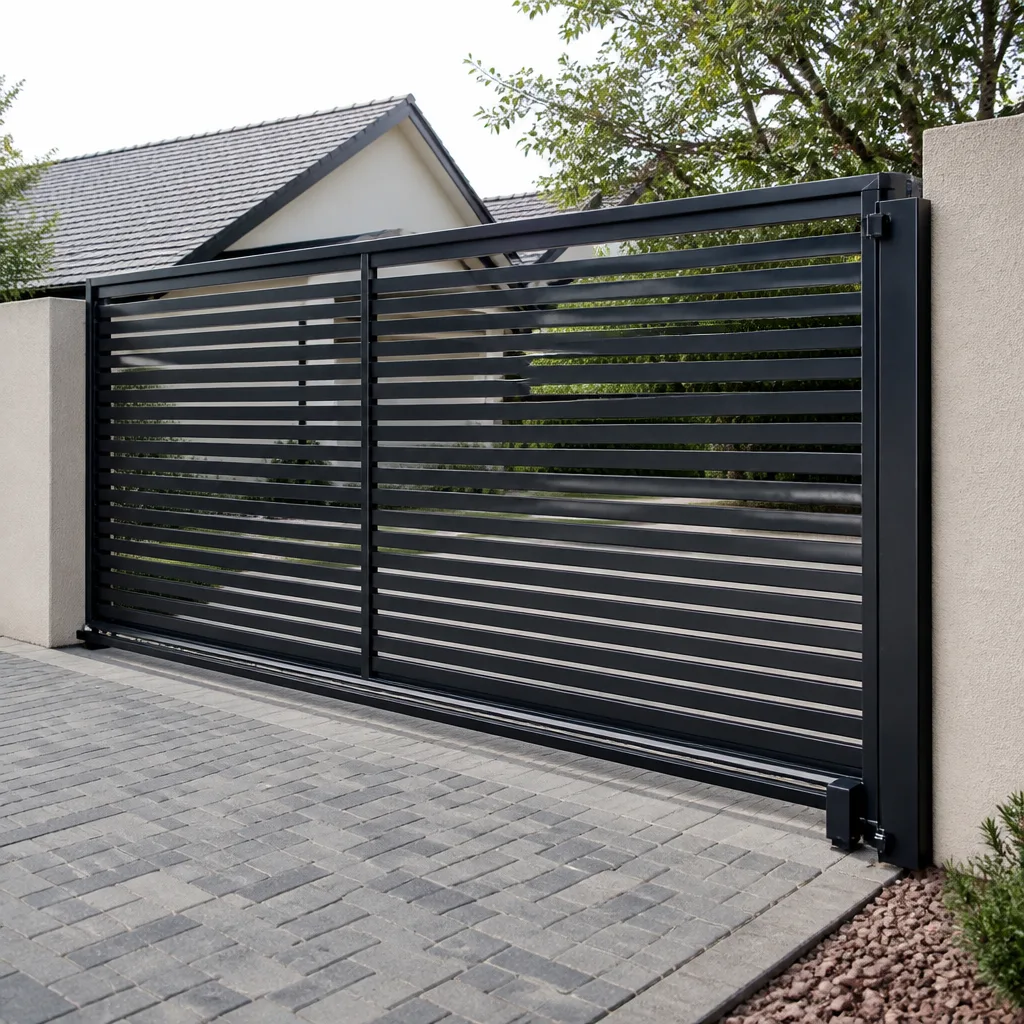 Sliding driveway gates
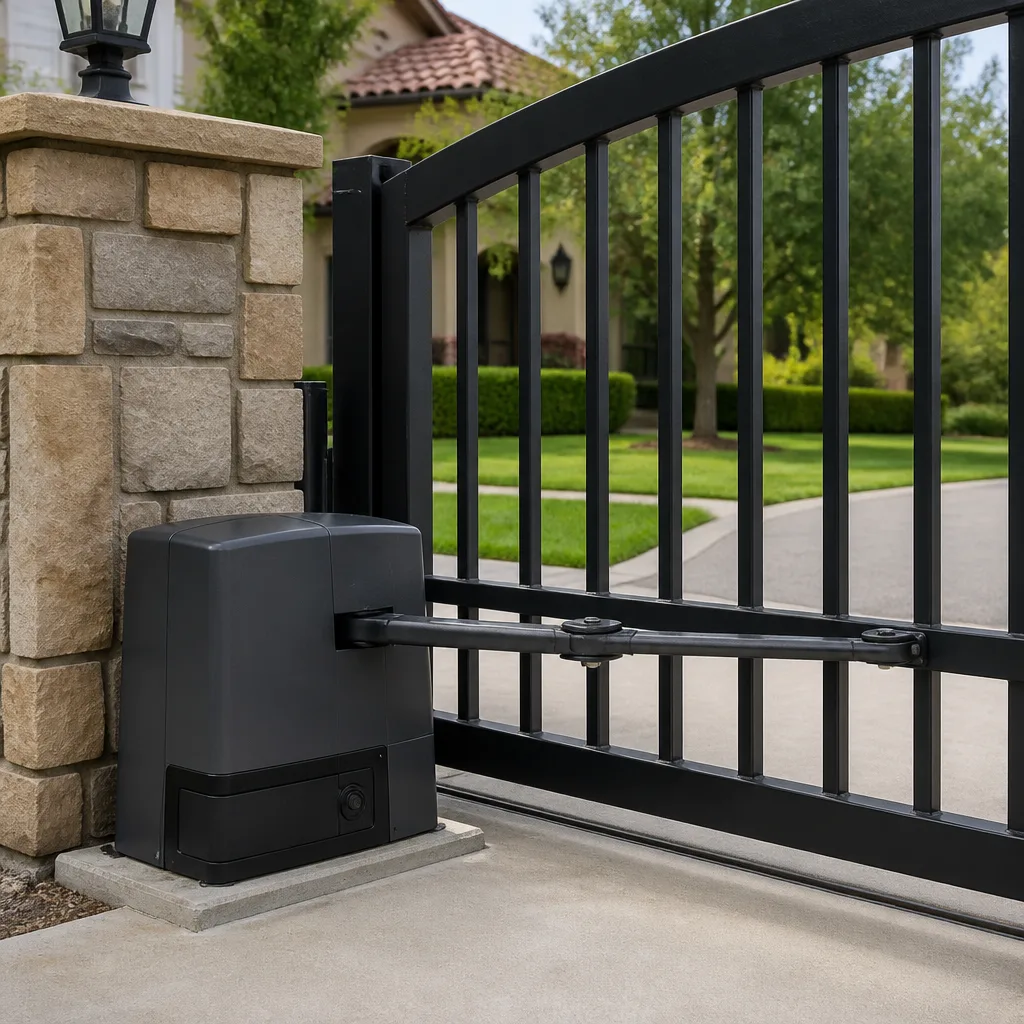 LiftMaster operators
Free on-site gate assessment - hinges, posts, and your LiftMaster or Nice gate operator checked before anything is quoted
The assessment is free and the quote is the invoice.
Get your free estimateChoosing the Right Gate Repair Brand: A Buyer’s Guide for Union City
A gate operator rated for “residential use” assumes a gate that cycles 6 to 10 times per day. If you have a multi-unit property on Decoto Road, or a household where work-from-home traffic pushes your gate to 20 or 30 cycles daily, that rating difference determines whether your operator lasts two years or ten. Most gate failures in Union City don’t start with a broken motor. They start with a brand and duty rating that were never matched to how the gate actually gets used.
This guide walks through what actually matters when choosing our Gate Repair services and the right brand in Union City: parts availability in Alameda County, technician familiarity, duty cycle ratings, warranty terms, and how our specific climate shortens or extends the life of different brands. You’ll finish with a clear framework for deciding which brand is right for your gate, and which ones are more likely to turn a $400 repair into a recurring headache.
Quick Answer
The best gate repair brand in Union City is the one your technician knows deeply and the one with parts stocked within Alameda County, not necessarily the one with the biggest marketing presence. For most Union City residential properties, LiftMaster and Mighty Mule strike the right balance of parts availability, technician familiarity, and climate suitability. For commercial or high-traffic gates, FAAC and BFT hold up better to continuous duty cycles but have longer parts lead times in our service area.
Styles & brands we work with
- Wrought iron
- Wood & steel frame
- Farm & ranch
- Sliding driveway gates
- LiftMaster operators
Table of Contents
- What Actually Matters When Choosing a Gate Brand in Union City
- Duty Cycle Ratings Explained: The Leading Cause of Premature Failure
- How the Major Gate Brands Compare for Union City Properties
- Parts Availability and Lead Times in Alameda County
- Warranty Comparison: What’s Covered, What’s Excluded, What Voids It
- Why Technician Familiarity Matters More Than Brand Loyalty
- How Union City’s Climate Affects Gate Operator Performance
- A Simple Framework for Choosing Your Gate Brand
What Actually Matters When Choosing a Gate Brand in Union City
Most buying guides start with “best overall” rankings. That’s backwards, especially in Union City. What matters here is a combination of three factors that generic national rankings miss entirely: whether a brand’s parts are stocked locally, whether Union City technicians actually see that brand often enough to diagnose it quickly, and whether the brand’s design assumptions match our climate.
Union City sits in a marine-influenced zone where summer fog rolls in from the bay and winter brings consistent moisture. Steel components corrode. Circuit boards get condensation exposure. Brands designed for dry inland climates, like parts of Arizona or Nevada, can struggle here if their enclosures aren’t well-sealed.
Here’s what actually drives repair success in our experience servicing gates across Union City:
- Local parts stock. A brand with distribution through Bay Area suppliers means your gate is down for a day, not a week. We work on LiftMaster, FAAC, BFT, and Linear systems specifically, and the difference in turnaround time between a LiftMaster part and a specialty BFT part is often measurable in days, not hours.
- Technician repetition. Technicians who see the same brand weekly build pattern recognition. They know that a certain LiftMaster board failure tends to precede a capacitor issue, or that a particular FAAC limit switch fails in a predictable way. That speed comes from repetition, and repetition comes from market share.
- Climate compatibility. Each brand has enclosure quality, board sealing, and material choices that perform differently in Union City’s specific damp-and-mild pattern. More on this below.
We only work on gates. That means every diagnostic we run, every part we stock on our trucks, and every training session we sit through is gate-specific. When a reader asks whether brand matters, the honest answer is that brand matters less than the intersection of brand, climate, and local service infrastructure. In Union City, that intersection favors brands with deep Bay Area distribution and heavy local adoption.
Duty Cycle Ratings Explained: The Leading Cause of Premature Failure
Duty cycle is the most misunderstood specification in gate automation. It’s not a measure of speed or power. It’s a measure of how long an operator can run before it needs to cool down, expressed as a percentage of a time window. A residential-class operator typically carries a 10% to 25% duty cycle. A commercial-class operator carries 50% or higher. A continuous-duty industrial operator can run essentially without stopping.
Here’s what those numbers mean in practical Union City terms:
- Residential duty (10-25%): Designed for a single-family home where the gate cycles 6 to 10 times daily. Each cycle is short. The operator cools down between uses. If your household has two cars, a delivery or two, maybe a gardener, this rating works.
- Commercial duty (50%+): Designed for apartments, condo complexes, office parking lots, and any property where the gate cycles dozens of times per hour during peak hours. Think of an apartment building on Alvarado-Niles Road where residents come and go in waves.
- Continuous/industrial duty: Designed for warehouse yards, distribution centers, or any installation where the gate may cycle hundreds of times per shift. Overkill for residential, but necessary for Union City’s industrial corridors off Whipple Road.
Mismatching is what kills operators early. We’ve replaced LiftMaster residential operators on multi-unit properties that were cycling 40 times a day because the original installer chose the cheapest option that fit the physical gate, not the option that matched the traffic. The operator didn’t fail because LiftMaster is a bad brand. It failed because a residential duty rating was applied to a commercial workload.
The same happens in reverse, and it’s less harmful but still worth knowing. A commercial-grade FAAC operator on a single-family gate is overkill in cost and complexity, but it won’t fail early. It just costs more than necessary and may be louder than a residential unit should be. For Union City homeowners with standard traffic, a residential-class LiftMaster or Mighty Mule is appropriate. For property managers responsible for apartment gates, warehouses, or any gate that cycles heavily, step up to commercial duty.
The rule we use with customers: if your gate cycles more than 15 times per day consistently, you need at least a light-commercial rating, regardless of what the marketing language says. “Residential” is a workload assumption, not a quality judgment.
How the Major Gate Brands Compare for Union City Properties
This section compares the brands we see most often in Union City, with specific attention to how they handle our climate, our property mix, and our service ecosystem. Prices below are typical installed repair or replacement ranges for the Alameda County market, not national averages.
LiftMaster
LiftMaster is the most common brand we encounter in Union City residential gates. It shares parts architecture with Chamberlain and has the deepest distribution network of any residential gate brand in the Bay Area. That means when a LiftMaster control board fails, we typically have the replacement in our truck or at a local supplier same-day. From a repair-cost perspective, LiftMaster’s ubiquity is its biggest advantage. Parts are reasonably priced, documentation is mature, and every gate technician in Union City knows the failure patterns backwards.
Climate-wise, LiftMaster’s residential units hold up acceptably in Union City’s damp conditions, with one caveat: their battery backup units benefit from being mounted in a sealed enclosure position away from direct fog exposure. We’ve seen battery corrosion issues on units installed facing the bay wind side of properties near Eden Shores and the wetlands. That’s manageable with proper installation.
FAAC
FAAC is an Italian brand with serious engineering credibility in hydraulic and electromechanical operators. We see FAAC on higher-end residential estate gates in Union City’s hillside areas and on commercial properties that need slow, heavy-gate operation. FAAC’s hydraulic operators run smooth and quiet, and they handle heavy ornamental gates that would tax a smaller residential operator.
The tradeoff is parts availability. FAAC parts are specialized and often ship from regional or national warehouses rather than local Bay Area distributors. That means a simple sensor replacement on a FAAC system can take 3 to 5 days if the part isn’t in our own stock. When we work on FAAC systems, we’re aware of this lead time and plan diagnostics accordingly. The brand itself is excellent. The infrastructure around it in Union City is thinner than LiftMaster’s.
BFT
BFT is another Italian manufacturer, and like FAAC, it’s a favorite for commercial installations. We see BFT operators on apartment complexes, storage facilities, and industrial gates around Union City’s commercial corridors. BFT’s hydraulic units are workhorses capable of sustained duty cycles that would shred a residential operator in under a year. Their electronics are generally well-sealed against moisture, which matters in our fog-prone microclimates.
The tradeoff mirrors FAAC’s. BFT parts have longer lead times in Alameda County. They’re not impossible to source, and our familiarity with the brand means we can diagnose accurately on the first visit, but there are fewer local stock options than with LiftMaster or Linear. For commercial Union City properties where downtime means resident complaints or blocked deliveries, we recommend having critical BFT parts on-site or budgeting for expedited shipping.
Linear
Linear has deep roots in access control and gate automation, and we see it frequently in Union City’s multi-family and light commercial settings. Linear’s strength is integration with telephone entry and access control systems, which matters for apartment callboxes and mixed-use properties. Their operators are reliable and their duty ratings are conservative, meaning a Linear commercial unit does what it says it’ll do.
Parts availability for Linear sits between LiftMaster and the Italian brands. Linear has good Bay Area distribution, though not quite as deep as LiftMaster. Linear’s pricing for boards and control electronics runs higher than LiftMaster’s equivalent parts, something to budget for on repair work. If your Union City property already has a Linear telephone entry system, staying with Linear for the gate operator keeps integration simpler.
Brand comparison summary for Union City:
- Residential, moderate traffic: LiftMaster or Mighty Mule. Deepest parts availability, lowest typical repair costs, strong technician familiarity.
- Residential, heavy or ornamental gate: FAAC or Elite. Smooth operation, better for steep driveways or heavy wrought iron.
- Commercial, apartment or office: BFT or FAAC. Built for continuous duty, sealed electronics, longer parts lead times requiring planning.
- Multi-family with access control: Linear. Tight integration with entry systems, solid commercial duty ratings, mid-range parts cost.
Our job at Gate Repair in Union City is to match the brand to the property, not to push one we prefer. We’re brand-agnostic. We fix what you own, and when replacement makes more sense, we walk through the tradeoffs in plain terms.
Parts Availability and Lead Times in Alameda County
Parts availability is the unglamorous factor that determines whether your gate is down for a day or a week. In Union City, we’re served by a network of Bay Area gate and access control parts distributors, but not every brand has equal representation.
Here’s what we see in practice:
- LiftMaster: Best availability. Common boards, arms, receivers, and safety sensors are stocked by at least two local distributors. Same-day or next-day turnaround for most repairs.
- Linear: Good availability for common components. Less deep stock than LiftMaster, but common boards and sensors are typically available within 1 to 2 days.
- Mighty Mule and Ghost Controls: Consumer-grade parts often stocked at local hardware and farm supply stores, but replacement electronics sometimes require online ordering. 2 to 4 days typical for non-stocked items.
- FAAC and BFT: Thinnest local stock. Many parts ship from regional or national warehouses. 3 to 7 days for non-stocked components, sometimes longer for hydraulic-specific parts.
- DoorKing and Elite: Middle ground. Some local stock exists through Bay Area distributor networks, but obscure components still ship from out of area.
These lead times matter more when your gate is inoperable. A sliding gate stuck open on a commercial property is a different urgency than a driveway gate that can be manually opened and closed. For Union City properties that can’t tolerate multi-day downtime, we recommend two things: stick with brands that have local stock (LiftMaster for residential, Linear for commercial), and if you own a FAAC or BFT system, consider keeping critical spare parts on a shelf.
Our own truck stock skews toward the brands we service most in Union City, which reflects brand adoption in this market rather than any manufacturer preference. When we say electric gate repair in Union City is our specialty, part of that specialization is knowing which supplier has what, on which day, at what price, before we even pull up to your property.
Warranty Comparison: What’s Covered, What’s Excluded, What Voids It
Warranty terms vary enough between gate brands that they should influence your decision, especially for new installations in Union City. Here’s a factual breakdown of what to expect from each brand level:
Residential Brands (LiftMaster, Mighty Mule, Ghost Controls)
- LiftMaster: Typically 1 to 5 years on the operator depending on model, with longer coverage on motors and gear assemblies. The catch: LiftMaster’s better warranties require installation by a qualified technician. DIY installation drops coverage to the shortest term, and in some cases voids it entirely if installation error causes the failure.
- Mighty Mule: Generally 12 to 18 months on electronic components, with a shorter window on accessories. Mighty Mule products are designed for DIY installation, which means warranty claims don’t require proof of professional installation, but they do require purchase documentation and serial number registration.
- Ghost Controls: Comparable to Mighty Mule, with limited warranty windows on boards and motors. Easiest claims process of the residential brands in our experience, but repair parts often ship by mail rather than being locally available.
Commercial and Premium Brands (FAAC, BFT, DoorKing, Viking, Elite, Linear)
- FAAC and BFT: 2 to 3 year warranties are common on hydraulic operators, but these warranties almost universally require factory-authorized technician installation and maintenance documentation. If a non-authorized person opens the hydraulic system and damage results, the warranty is gone.
- DoorKing and Viking: Strong warranty terms on commercial operators, often 2 to 5 years on major components. Like FAAC and BFT, professional installation documentation is typically required for full coverage.
- Elite and Linear: Mid-range warranties with standard exclusions for environmental damage, power surge damage, and unauthorized modification. Power surge protection is worth adding on any Union City installation regardless of brand.
Here’s what almost every warranty in the gate industry excludes, regardless of brand:
- Damage from power surges or lightning (Bay Area storms are real, and gate boards take the hit)
- Water damage from improper installation or enclosure positioning
- Damage from physical impact to the gate itself
- Normal wear items like hinges, wheels, chains, and safety edge sensors
- Failures caused by mismatch between operator duty rating and gate usage
That last exclusion matters enough to repeat. If you install a residential operator on a gate that cycles 25 times a day and the motor burns out at year three, the manufacturer will ask about usage before honoring the warranty. We write this down for every Union City customer making a brand decision: pick the duty rating first, then pick the brand.
Why Technician Familiarity Matters More Than Brand Loyalty
A gate brand is only as good as the technician diagnosing it. This sounds obvious, but it becomes concrete when you understand that most gate repair problems are diagnosed through pattern recognition, not through schematics. A technician who has replaced 200 LiftMaster control boards knows the failure sequence, the common wiring issues, the test points that matter. A technician seeing a BFT system for the first time will be slower, more cautious, and more likely to order the wrong part.
In Union City, technician familiarity matters because of market concentration. LiftMaster and Mighty Mule dominate residential installations. Linear and DoorKing dominate multi-family. FAAC and BFT appear selectively on commercial and high-end residential projects. That distribution means every gate technician in the Bay Area has deep LiftMaster reps, moderate Linear and DoorKing reps, and fewer FAAC and BFT reps.
This doesn’t mean FAAC and BFT are bad brands, or that you should avoid them. It means that if you choose them, your technician selection matters more. You want a team that works on those brands specifically, not someone who occasionally encounters one.
Our service area centers on Union City, and across every call we run, the pattern holds: repair speed and first-visit success rate are highest on the brands we see most. For a Union City homeowner choosing between a LiftMaster and a less common brand, this is a legitimate factor. A part stocked locally and a technician who knows the failure mode by heart will get your gate fixed before a rarer brand’s replacement part even ships.
We work on nine gate and operator brands: LiftMaster, FAAC, BFT, Linear, Viking, Ghost Controls, DoorKing, Elite, and Mighty Mule. That breadth matters because Union City properties run the full range from DIY Mighty Mule setups on residential driveways to BFT hydraulic operators on commercial slide gates. We don’t push customers toward one brand family. We diagnose what’s in front of us, explain the options, and fix from the motor to the hinge.
How Union City’s Climate Affects Gate Operator Performance
Union City’s climate is the quiet variable that most gate-buying guides miss. We don’t get Sacramento Valley heat. We don’t get South Bay dry spells. We get cool mornings, bay fog rolling through the Alvarado corridor, consistent winter moisture, and air that carries salt and humidity from the bay’s edge.
Here’s what that means for gate equipment:
- Condensation inside control boxes. When a control board sits in an enclosure that’s not sealed against temperature swings, the internal air expands and contracts, drawing in moist outside air. Over time, that moisture condenses on the board. We’ve opened control boxes in Union City that look like they’ve been sprinkled with a garden hose, purely from seasonal condensation. Brands with well-sealed enclosures, like BFT and higher-end LiftMaster models, handle this better than budget consumer units.
- Corrosion on steel gate hardware. Hinges, wheels, chains, and bolts oxidize faster in Union City’s damp air than they would in a dry inland climate. This isn’t an operator brand issue, but it is a repair cost issue. Galvanized or powder-coated hardware pays for itself here.
- Battery backup degradation. Union City doesn’t see extreme cold, which is good for lead-acid batteries. But consistent mild temperatures with humidity still degrade battery plates over time. We typically see 3 to 4 years of usable life from a gate battery backup in Union City before it starts dropping capacity.
- Fog exposure near the bay side of the city. Homes near the western edge of Union City, close to the wetlands and Coyote Hills, get more consistent fog. Salt content in coastal fog accelerates corrosion. For these properties, sealed enclosures and marine-grade hardware are worth the premium.
None of this is catastrophic. But a brand choice that ignores these conditions will cost you in maintenance frequency. A budget operator with a porous enclosure will fail faster in Union City than it would in, say, Livermore. When we evaluate a replacement for a Union City gate, climate compatibility is one of the five factors we score before recommending a unit.
Gate installation in Union City needs to account for these microclimate realities. Proper enclosure sealing, strategic component placement, and appropriate corrosion protection are part of what separates an installation that lasts 15 years from one that starts rusting and shorting at year 5.
A Simple Framework for Choosing Your Gate Brand
If you’ve read this far, you have enough context to make a smart decision, or explore more guides & resources. Here’s the framework we use with Union City customers. Work through these five questions in order:
- What does your gate actually do? Count real cycles per day. If it’s under 10, residential duty works. If it’s above 15, you need light-commercial. If it’s above 30, step up to commercial duty. This single answer eliminates half the brand confusion.
- What’s your downtime tolerance? If your gate is on a single-family home and you can manually operate it while waiting for parts, almost any brand works. If your gate secures an apartment complex or business and downtime costs you, choose a brand with local parts stock or keep critical spares on hand.
- What’s your climate exposure? Properties near the bay side of Union City, with consistent fog and moisture, need better-sealed equipment and corrosion-resistant hardware. Budget brands fail faster in these conditions.
- Who will service the gate? Match the brand to the technician ecosystem you can access in Union City. LiftMaster and Mighty Mule have the deepest service infrastructure. FAAC and BFT require more selective technician choices but are excellent when properly serviced.
- What’s the 10-year cost, not the upfront price? A budget operator that lasts 3 years is more expensive than a mid-range operator that lasts 8, once you factor in labor. This is the mistake we see most often in Union City: price-per-unit decisions that ignore labor costs.
The brand that emerges from this process is usually the right one for your specific property. We’ve helped Union City homeowners and property managers work through exactly this sequence, as detailed in The Complete Gate Repair Guide for Union City Homeowners, and the answer is often different from what an online “best gate brands” list would produce. That’s the point. Your gate, your traffic pattern, your exposure to bay air, your downtime tolerance. That’s what should drive the decision.
Common Mistakes to Avoid
- Buying the cheapest operator that fits. A low-cost operator on a high-traffic gate burns out within years, and you pay for the cheap operator again in replacement parts and labor. Union City multi-unit properties are the most frequent victims of this mistake.
- Ignoring duty cycle entirely. Most buyers compare horsepower and price, never duty cycle. A 1/2 HP residential operator and a 1/2 HP commercial operator are different machines for different workloads.
- Choosing a brand with no local parts support. That specialty European operator may be beautifully engineered, but if the one part you need ships from a warehouse in another state, your gate is down for a week. For Union City properties, this is a risk assessment, not an abstraction.
- DIY-installing a brand that requires authorized installation for warranty coverage. You save the install fee and lose the warranty. On higher-end FAAC or BFT systems, that’s a significant trade.
- Matching a new operator to a dying gate. If your gate’s hinges, wheels, and frame are worn out, a new operator will strain with every cycle and fail early. Fix the gate first, then automate it. We see this mistake on older Union City properties where the iron gate predates automated access by decades.
- Forgetting power and surge protection. Our winter storms bring power flickers, and gate control boards are sensitive. A $60 surge protector can save a $400 board. Almost nobody installs them, and we fix the result.
- Choosing a brand for the wrong gate type. A swing gate operator and a slide gate operator are not interchangeable. Buying the wrong type for your gate configuration is a guaranteed redo.
See the difference
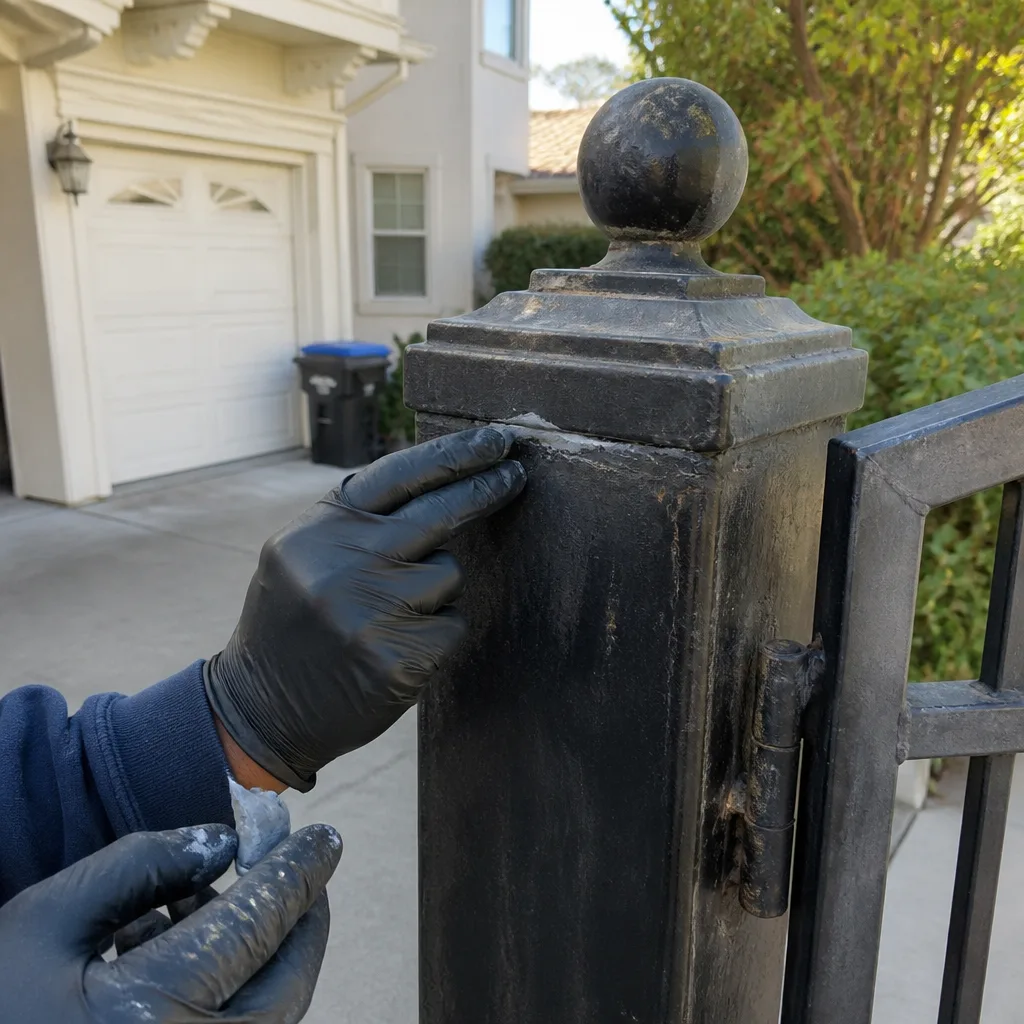
 Before
 After
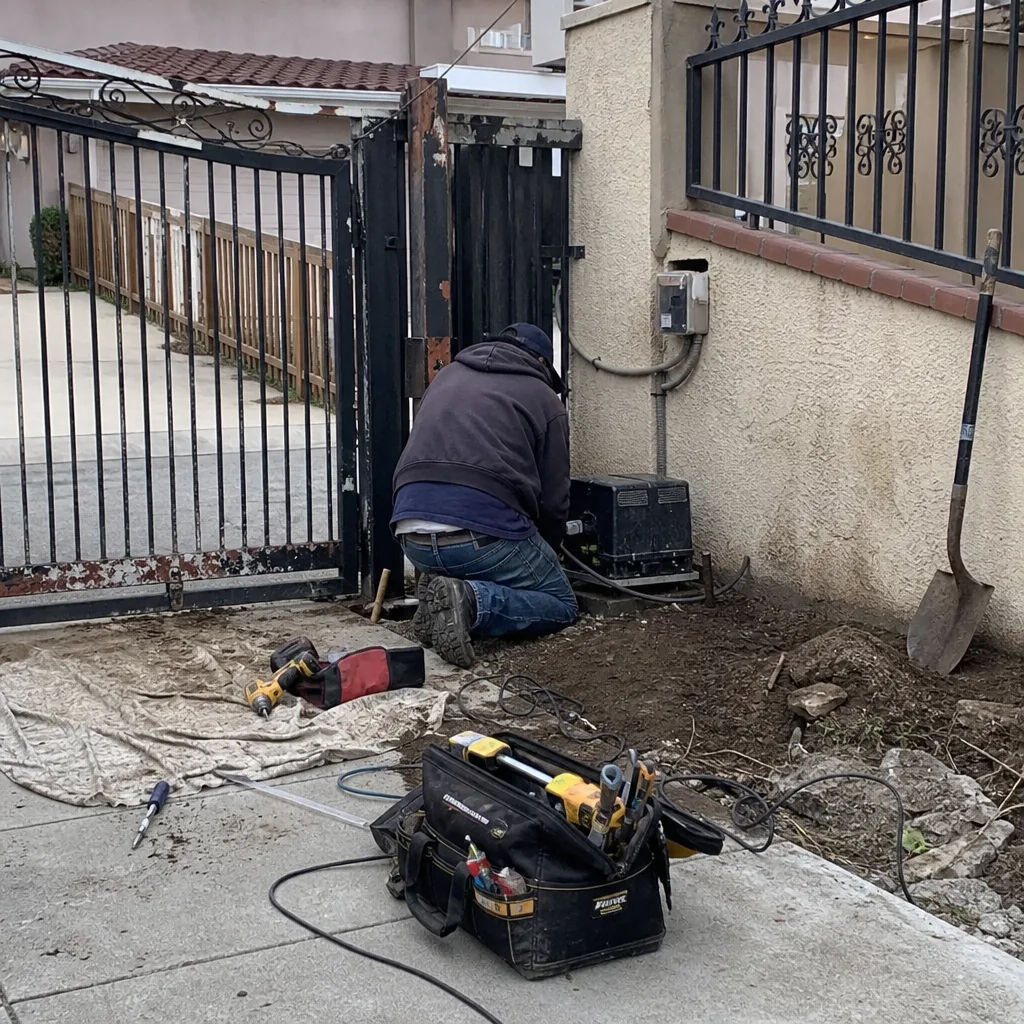 Before
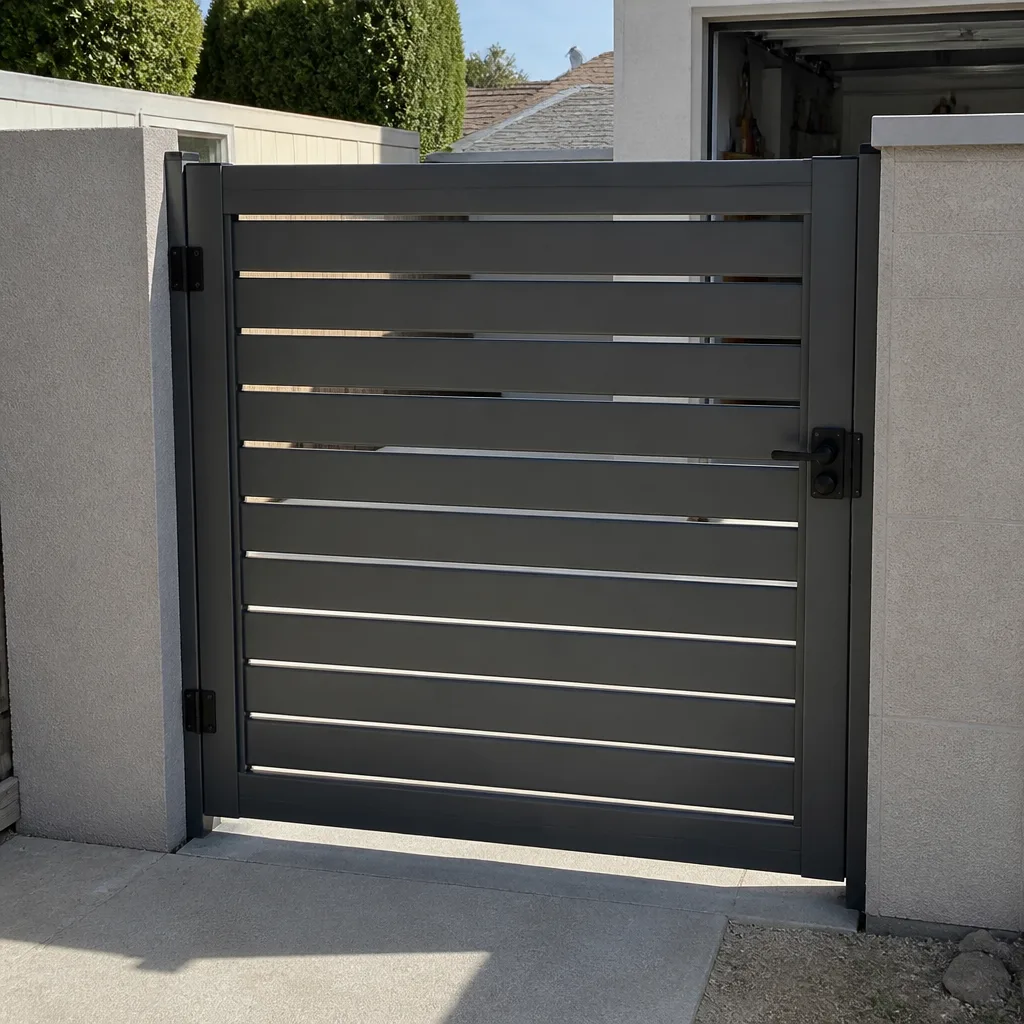 After
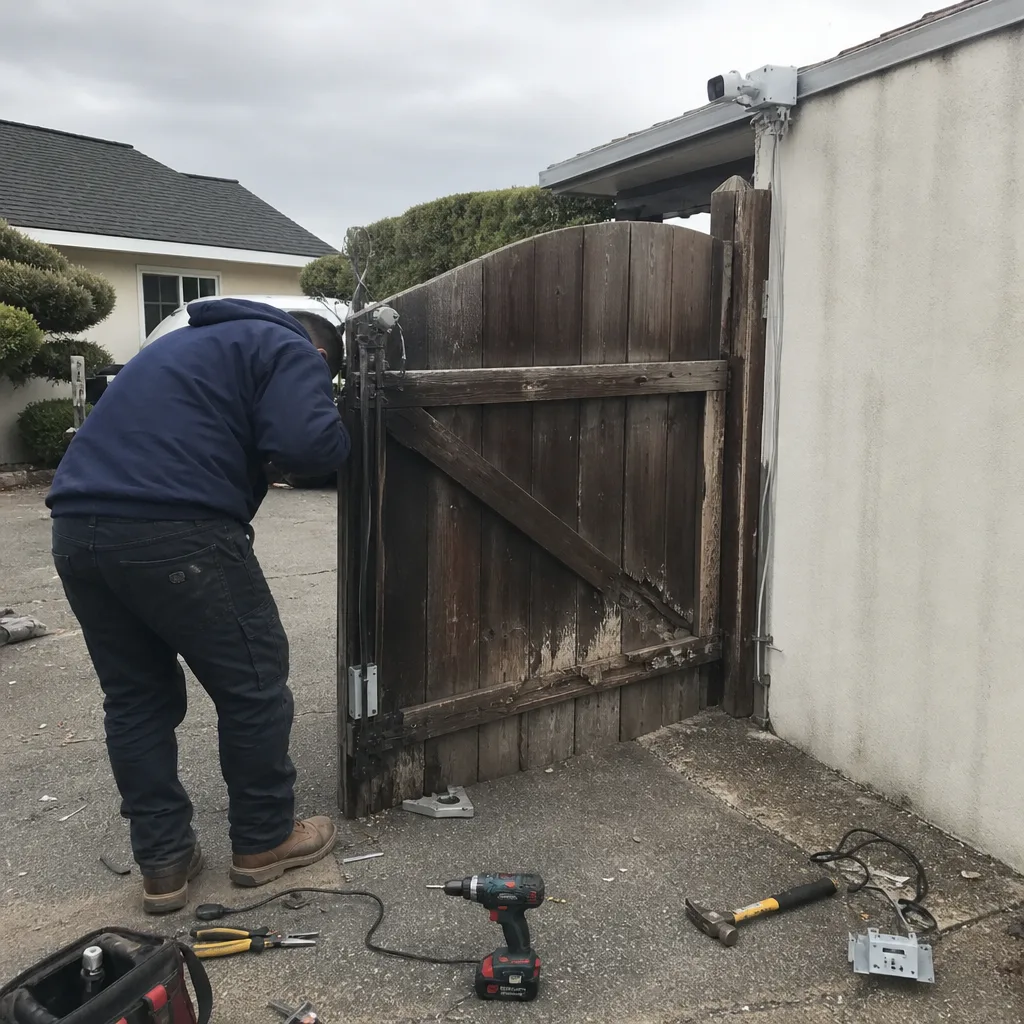 Before
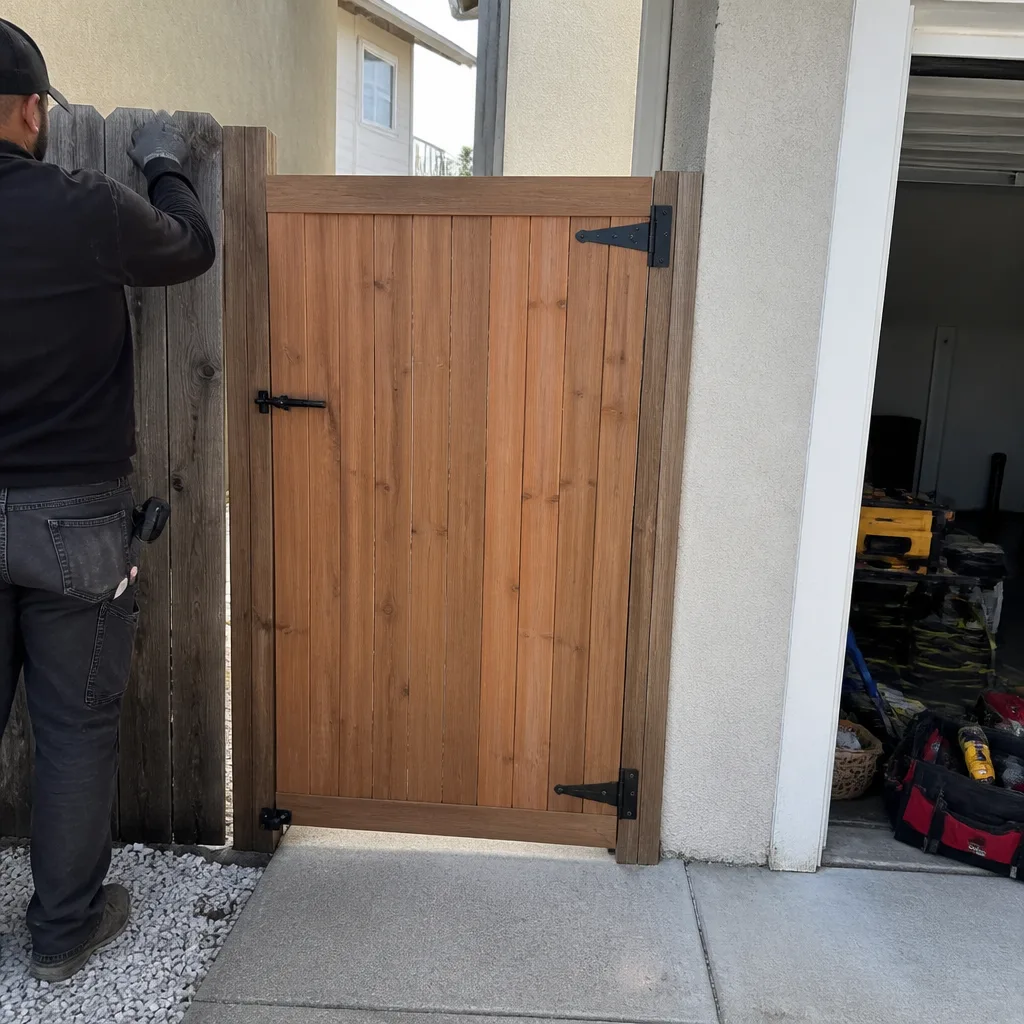 After
When to Call a Professional
Gate issues that involve electric components, control boards, safety sensors, or high-tension hardware should be handled by someone who works on gates every day. A gate that won’t respond to remotes, a board that’s clicking but not engaging, a safety sensor that’s failing intermittently, a slide gate that’s binding on its track: these are diagnostic problems, not part-swapping exercises. The danger is real on high-tension springs and heavy automated gates. A gate under motor load carries enough force to cause serious injury if a component releases unexpectedly. If you’re unsure what you’re looking at, shut the system down and call someone who can diagnose it safely. We only do gates, which means when we arrive, we’re not learning on your equipment. If your gate is acting up anywhere in Union City, call (833) 593-6430 for a free estimate. We’ll tell you what’s wrong, what it costs, and what your brand options are, before any work begins.
Frequently Asked Questions
LiftMaster is the most reliable residential brand for Union City specifically because it combines adequate weather sealing with deep parts availability in Alameda County. For commercial properties, FAAC and BFT hold up best to continuous duty cycles and have well-sealed enclosures, though their parts ship from farther away.
Gate repair in Union City typically ranges from $200 to $800 for common fixes like sensor replacement, remote reprogramming, or hinge repair, while control board or motor replacement can run $500 to $1,800 depending on brand and duty rating. Call (833) 593-6430 for a specific quote on your setup, since brand, gate type, and accessibility all shift the number.
LiftMaster has the strongest parts availability in our area, with common components stocked by multiple Bay Area distributors and often available same-day. Linear and Mighty Mule are middle-ground, while FAAC and BFT parts frequently ship from regional warehouses and take 3 to 7 days for non-stocked items.
We service nine major brands, LiftMaster, FAAC, BFT, Linear, Viking, Ghost Controls, DoorKing, Elite, and Mighty Mule, which covers the vast majority of systems installed in Union City. If you own something outside that range, call us and we’ll tell you honestly whether we can source parts and service it effectively.
Duty cycle means how long an operator can run before needing to cool down. A residential rating assumes 6 to 10 gate cycles per day, which fits a typical single-family Union City home. If your gate cycles more than 15 times daily due to multiple drivers, deliveries, or a home business, you need a light-commercial rating regardless of what brand you choose.
For most commercial and premium brands, including FAAC, BFT, DoorKing, and Viking, warranty coverage requires installation by a qualified or factory-authorized technician. For consumer brands like Mighty Mule and Ghost Controls, DIY installation doesn’t void warranty, but installation errors that cause the failure are excluded from coverage.
A properly matched residential gate operator in Union City should last 8 to 12 years with normal maintenance, and a commercial-duty operator 10 to 15 years. Mismatched duty ratings are the number one reason we see operators fail at year 3 to 5 instead.
LiftMaster and Mighty Mule dominate residential installations across Union City, while Linear and DoorKing are common on multi-family properties. FAAC and BFT appear on higher-end residential and commercial sites. This distribution means local technician familiarity is strongest on those first brands.
The Bottom Line
The right gate brand for your Union City property is the one matched to your actual usage, your climate exposure, your downtime tolerance, and the technician ecosystem you can reach. Duty cycle beats brand name every time. Parts availability beats marketing. And a brand’s engineering quality only matters if the technician diagnosing it knows the system deeply and can get parts quickly. For most Union City residential gates, LiftMaster is the practical choice. For heavier traffic and commercial work, FAAC, BFT, and Linear earn their higher cost through sustained duty capability. Whatever you choose, verify the duty rating first, build in surge protection, and pick a service team that works on your brand specifically, not one that’s seeing it for the first time.
If your gate is already misbehaving, we can help. Gate Repair Union City home is your starting point for a free estimate. We’ll diagnose what you own, tell you what it needs, and give you an honest read on whether repair or replacement makes more sense. Your gate, fixed right.
Written by the team at Gate Repair Union City, serving Union City since 2018.